For info: Phone: +39 339 5489761 - Email: info@primerelocationitaly.com
Prime Relocation Italy
Prime Relocation Italy

Prime Relocation Italy
Contact Us
Connect with us to discover exclusive relocation and property solutions designed to make your move to Italy seamless and successful.
Share your needs with us — we’ll review your request and provide personalized feedback on how we can assist in your specific case.
We welcome confidential inquiries.
Phone: +39 339 5489761
Email: info@primerelocationItaly.com
Lump Sum Tax Regime for High Net Worth Individuals

In 2025, Italy is uniquely placed as a safe haven destination for the world’s wealth. The country’s (recently amended) €200,000 Flat Tax regime for HNWIs and UHNWIs historically played second fiddle to the likes of the UK’s Non-Dom Status regime…
Until March 6, 2024, that was, when the UK Chancellor announced the end of the Non-Dom regime, effective April 6, 2025, in favour of a residency based tax system.
Portugal, too, will be replacing their massively popular Non-Habitual Residency – now terminated – with a watered-down version of the program – the so-called NHR 2.o – in the near future.
Even Dubai, which used to be completely tax-free, has recently introduced corporate taxation.
And so, as the adage goes, now all roads lead to Rome for those seeking Non Dom tax benefits.
For high net worth migrants seeking a new tax home, Italy’s Flat Tax Regime offers excellent advantages. For eligible applicants, it replaces the country’s progressive tax system on worldwide income with a single flat tax levy for a period of 15 years (up from €100,000 to €200,000 in 2025).
Additional eligible family members can be added to this flat tax regime for an additional levy of €25,000 per fiscal year.
The regime covers foreign sourced income, but tax residents cannot deduct any taxes they already paid abroad from this amount.
And by obtaining an advanced tax ruling, applicants can ensure legal and fiscal certainty ahead of actually relocating to Italy.
This can also prevent unintended tax liabilities from being triggered upon relocation, however working with a knowledgeable tax expert in obtaining an advanced tax ruling from Agenzia delle Entrate is essential.
Let’s take a look at the Italian Non Dom regime’s benefits below…
Italy Flat Tax Regime
the ultimate guide
Individuals becoming a tax resident of Italy can opt for the Special Flat Tax Regime for High-Net-Worth Individuals (HNWI) only if, during the ten years before their relocation, they did not qualify as tax residents of Italy for at least nine years.
In a nutshell, this grants a flat taxation - amounting to 200,000 euro (per year) - on income from foreign (non-Italian) sources, regardless of their amount and/or nature.
The only foreseen exception to this general rule is for capital gains realized during the first five years of application arising from the sale of qualified shareholdings. Those gains, even though deriving from foreign entities, are subject to ordinary Italian taxation at 26% (a rate that can be reduced to 16% under certain circumstances).
In addition, the qualification under the Flat Tax Regime provides an opportunity to avoid the following taxes, and tax filing obligations, on income subject to the flat tax:
- filing of the declaration of investments held abroad (the so-called 'RW form')
- wealth tax on investment held abroad, saving 0.2% per year on the value of financial investment and 0.76% per year on the original cost of real estate properties held abroad
- inheritance and donation tax.
Under the Flat Tax Regime, any Italian-sourced income is subject to ordinary taxation.
The regime can be applied for fifteen consecutive years from the first year of tax residency, and the same benefit can be extended to family members whose foreign income is subject to an annual flat tax of 25,000 euro.
Financial income vs Employment income
It is important to bear in mind that an income is considered “from a foreign source” – and therefore falls within the scope of application of the 200k€ flat tax – if it is defined as such by the Italian tax law.
Even if the Italian tax law is substantially aligned with international principles, the country of source can be defined only after determining the nature of a given income; this factor, in turn, depends on the Italian tax law and practice, which may lead to unexpected results.
Depending on specific elements, carried interests under Italian law may be considered financial income or employment income. While financial income is usually considered produced in the country where it comes from (as this is generally the country where the investment is located), employment income is considered produced in the country where the related working activity is performed, no matter where the payment of such income comes from.
The implications of this difference are easy to imagine if the carried interests at issue are paid from abroad to an individual working in Italy. As for carried interest, the qualification of the relevant income depends on the way it is structured.
This is just one example which demonstrates how easy it is to face situations where the source of a given income can be different to the one initially imagined and, consequently, would impact how attractive the Flat Tax Regime would be when it comes to HNWIs and their individual specific case.
Other common challenging cases are those related to director’s fees; income indirectly related to immovable properties located in Italy, etc.
Once the nature and the country of source of an individual’s main income are clarified, the implications of the Flat Tax Regime for HNWI are also clear.
Planning in advance
Another element, however, which must also be considered is timing.
In our experience, the first Quarter of a new Italian tax year (from January to March) would be a good time to move to Italy. The central months of the year are probably the trickiest. This is mainly due to the way the fiscal year is conceived under the Italian tax law.
Generally, a fiscal year, which matches with the calendar year (Jan – Dec), cannot be split. As a result, when individuals move to Italy during the first quarter of a given year, they are likely to acquire tax residency for the entire year, starting from Jan 1. If they move later and, after their relocation, they travel abroad frequently, they may be unable to qualify as tax resident of Italy meeting the requirements to be considered resident in Italy.
For income tax purposes are considered residents, persons who, for most of the tax period, alternately:
- have residence in the territory of the State.
- have their domicile in the territory of the State ("the place where the person's personal and family relationships are mainly developed" );
- are present in the territory of the State;
unless proven otherwise, they are registered in the registers of the resident population.
The rule therefore identifies three alternative conditions for the purpose of identifying residence:
a) registration in the registry office (formal requirement);
b) domicile (substantial requirement);
c) residence (substantial requirement).
This factor may have a strong impact over tax planning.
In addition, in determining when to move, it is advisable to take into account some further practical – but not less relevant – aspects, such as:
•receiving adequate advice about Flat Tax Regime for HNWI and its actual application in each individual’s specific case
•(for non-EU citizens) defining the right approach to immigration and how its handled, as this may represent a significant obstacle if not managed properly from the beginning
•evaluating the opportunity to obtain an official ruling from the Italian Tax Authorities (ITA) about eligibility for Flat Tax Regime for HNWI.
In relation to the last factor listed above, it is crucial to obtain an answer from the ITA when the individual is still in the position to define his/her tax residence.
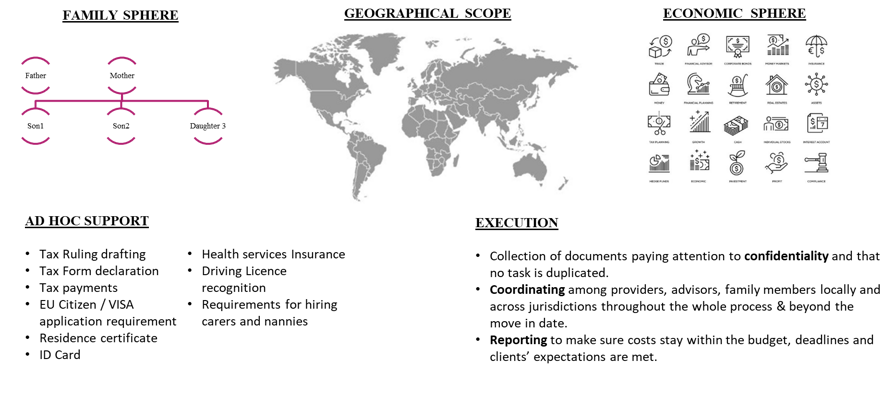
Main points to be analysed for an adequate Planning

Connect with us to discover exclusive relocation and property solutions designed to make your move to Italy seamless and successful. Share your needs with us, we’ll review your request and provide personalized feedback on how we can assist in your specific case.